Pre-Finetuning Evaluation of Large Language Models in Legal Consultation
Before deciding to finetune, test the model's performance on legal Q&A through carefully designed prompts. The concrete steps are:
- Gather representative legal questions: Work with the legal product team to collect a set of representative legal consultation questions and expected answers. These should cover common practice areas—contracts, labor law, family law, and so on—across typical consultation scenarios.
- Design varied prompt strategies: Write different prompt styles for these questions, including detailed instructional prompts (role and step-by-step guidance), example-driven prompts (few-shot examples of Q&A pairs), chain-of-thought prompts (requiring step-by-step reasoning), and so on. Experiment to find which prompt best guides the model toward accurate answers.
- Compare output quality: Evaluate the model's accuracy, professionalism, and consistency across different prompts. For example, check whether answers cite relevant statutes, whether reasoning is clear, and whether conclusions are correct. Involve legal experts to review outputs when needed.
- Iterate on prompts: Based on initial results, refine the prompt wording and structure and observe improvements. Prompt engineering typically requires iterative testing to reach the optimal prompt. If optimization already meets most consultation scenarios, the model may be ready for trial use without substantial finetuning.
In legal scenarios, prompt design can be very specific. For instance, require the model to list relevant statutes as justification, or remind users to consult a practicing lawyer at the end. Practical teams often maintain a "prompt handbook" documenting which phrasings effectively improve model outputs. The strength of prompt engineering is that it improves performance without changing the model itself, but it requires iterative testing. Maximize the potential of pretrained models through prompt engineering before deciding whether further finetuning is necessary.
Knowledge-Augmented Architecture
Technical basis: Knowledge-augmented architecture typically refers to Retrieval-Augmented Generation (RAG) systems. In legal consultation applications, RAG combines external legal knowledge bases with an LLM, allowing the model to retrieve relevant statutes or case law and generate answers based on them. The typical workflow is: a user asks a legal question; the system retrieves related statute passages from a law and case database; these passages are provided to the LLM as context alongside the user's query; the model generates a grounded answer. This architecture solves the problem that a general model may lack current or jurisdiction-specific legal knowledge—the model does not need to store all legal knowledge in its parameters but can query the knowledge base in real time, ensuring answer timeliness and accuracy. For frequently changing regulations or specialized legal domains, RAG is especially effective because it reduces the risk of inaccurate legal citations and provides traceable justification for answers.
Evaluation approach: Before finetuning, assess whether a knowledge-augmented architecture alone meets requirements:
- Prepare a legal knowledge base: Curate authoritative legal texts—current laws and regulations, representative case summaries, judicial interpretations—and load them into a retrieval system (such as a vector database). Data must be structured, for example by splitting statutes or judgments into searchable segments for precise retrieval.
- Build a retrieval-augmentation prototype: Create a simple RAG prototype. When a user asks a question, first vectorize it, retrieve relevant content from the knowledge base (the most relevant statutes, for example), then append these to a prompt and send to the LLM to generate an answer. Observe whether the model answers more accurately and specifically with this "open-book" access.
- Compare against retrieval-free performance: Compare RAG answers with answers the model generates using only internal knowledge. Focus on: Are the legal citations in RAG answers correct? Is the content more detailed? For complex legal questions, a model without retrieval might speak generically or mix up case law; with relevant regulations retrieved, answers typically hit the mark.
- Evaluate system complexity and benefit: Consider implementation cost at the same time. Introducing RAG requires maintaining and updating the legal database and retrieval service, adding system complexity. But if evaluation shows significant improvement in answer reliability—for example, reduced error rates or improved statute citation accuracy—the effort is worthwhile. In legal services, reliability outweighs other considerations; achieving reliable answers through architecture is often more trust-building than finetuning alone.
Practical recommendation: If evaluation shows that RAG significantly improves legal Q&A reliability, prioritize adding it to the system design. On one hand, you reduce dependence on the model's internal legal knowledge, letting it focus on language generation and logical reasoning. On the other hand, the legal database can be updated anytime, keeping information current. Practically, use existing open-source tools such as LangChain or LlamaIndex to quickly build vector-retrieval modules for legal documents, combined with existing large model APIs or open-source models to complete answer generation. Ensure retrieval result quality—for each user question, retrieve enough relevant passages without redundancy. In sum, knowledge-augmented architecture is often cost-effective in legal AI products; validate its impact carefully before committing to formal model finetuning.
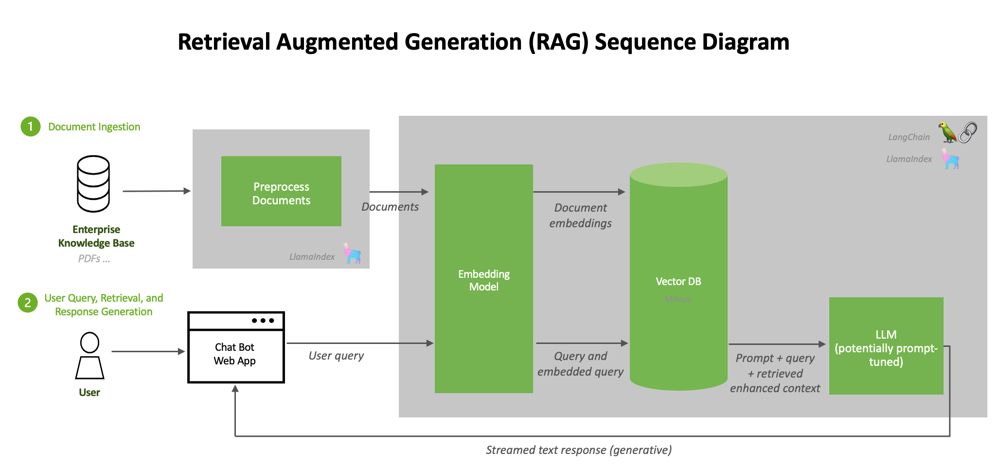
Retrieval Augmented Generation (RAG) architecture diagram: Process 1 (left) shows preprocessing and vectorizing legal knowledge documents into a knowledge base; Process 2 (below) shows how, after a user query, the system retrieves relevant vectors and sends both the results and the query to the LLM to generate the final answer. This architecture enables the LLM to answer questions based on real-time retrieved knowledge, improving accuracy and explainability.
Data Scale Evaluation
Technical basis: Before finetuning, you must verify whether the legal domain data at hand is sufficient to support effective finetuning. Data for finetuning involves not only quantity but also quality and coverage. If the data is sparse or unrepresentative, forcing finetuning may cause the model to overfit, potentially reducing generalization ability. Legal Q&A systems typically require large amounts of high-quality question-answer pairs or legal document summaries as training examples to teach the model professional expression and reasoning. The rationale for evaluating data scale is to understand whether more data will significantly improve model performance and whether existing data covers expected consultation scenarios. Cleanness, relevance, and representativeness must all be considered together. Cleanness means data is free of serious errors or noise; relevance means the content is genuinely in the legal consultation domain; representativeness means data covers major legal practice areas and question types, avoiding overrepresentation of any single type.
Evaluation approach: To assess data readiness, follow these steps:
- Count data volume and distribution: First inventory how many legal Q&A pairs are available for finetuning and their sources. For example, how many Q&A pairs, which legal topics are covered, and what is the proportion of data in each topic? This step can reveal whether sample size is insufficient or whether domain distribution is unbalanced.
- Small-scale finetuning experiment: To assess the effectiveness of existing data, run exploratory finetuning on a small subset of model parameters (for example, using low-cost methods like LoRA) or finetune using only a portion of the data. Then compare the model's performance before and after finetuning on a validation set of unseen legal questions. If finetuning on a small amount of data already produces visible improvement, data quality is likely high and direction is correct; if improvement is marginal, data may be insufficient or not aligned with model needs.
- Learning curve analysis: Through the small-scale experiment above, observe how model performance changes as training sample count increases. If performance continues to improve with more samples and shows no saturation, adding more data may further boost results; in that case, consider expanding data sources. If performance plateaus or declines quickly, existing data may be near saturation or have quality issues; rather than simply adding more data, improve quality or increase diversity.
- Check data quality and coverage: Sample and review training Q&A pairs to ensure answers are professionally correct and contain no legal errors. Also assess coverage of consultation scenarios: for example, does the data include both straightforward legal questions (such as divorce procedures) and complex case analyses (such as legal opinions on specific fact patterns)? If certain high-frequency consultation areas lack data, the finetuned model may perform poorly in those areas; gaps should be filled in advance.
Practical recommendation: If evaluation reveals insufficient data scale or quality, consider the following approaches: First, seek more data. For example, use publicly available legal Q&A corpora (court Q&A documents, legal forum Q&A) or leverage the large model itself to generate simulated Q&A pairs, then have experts validate them. Not all projects require massive datasets; small, well-curated datasets can also achieve high performance. The key is ensuring data aligns with real consultation needs and meets quality standards. Second, consider alternative finetuning approaches. With limited data, use incremental training, knowledge distillation, or few-shot alternatives; combine RAG architecture where needed to reduce the model's memory burden. In short, data evaluation is a gatekeeping step before finetuning any large model—effective finetuning depends on sufficient, suitable data.
Conclusion
Launching large-scale finetuning for legal consultation applications is not always the best strategy. By carefully evaluating prompt engineering, knowledge-augmented architecture, and data scale upfront, teams can make smarter decisions: solve with prompt optimization when possible instead of finetuning; rely on retrieval-enhanced architecture for reliable answers when the knowledge base is available; and only finetune when truly necessary, ensuring high-quality, sufficient data supports the effort. This approach reduces development risk and cost while producing more robust, trustworthy legal AI applications.